
Kelly Roden
Owner, Meliora Kitchens, Bedrooms & Bathrooms
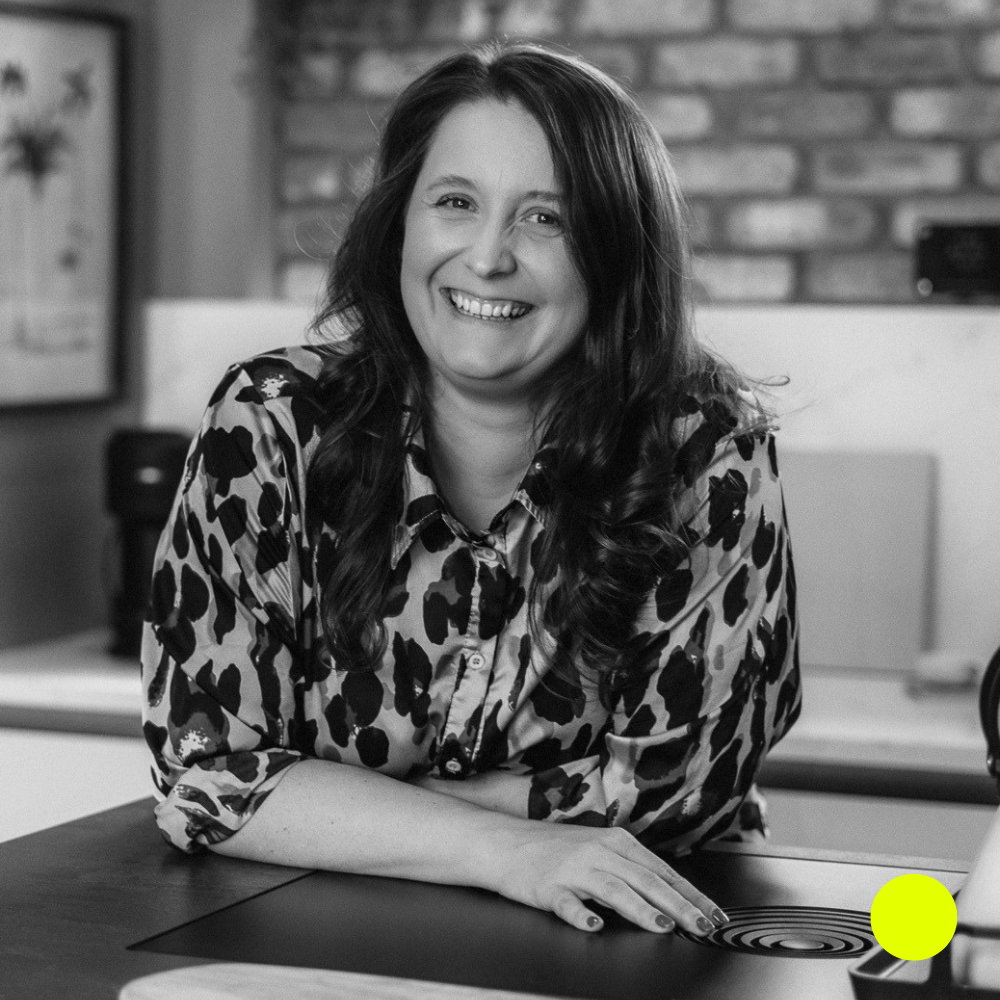
Kelly Roden shares how she and her husband built a client-focused business with high-end showroom displays and strong trade relationships, offering bespoke designs and end-to-end service.
Tell me about Meliora — how did it start?
Kelly: Leon started in the kitchen industry at Better Living back in 2007, doing direct sales — going out to customers’ houses, hand-drawing plans. Very much how it was done back in the day. I did all of his paperwork.
We had our first child in 2009, and a friend of his mentioned that a kitchen company called Wren was opening. Leon applied as a designer, which was our first foray into retail kitchen sales. I ended up working there too.
We both spent about five years at Wren in different roles as the business grew from nine stores to over 50.
We loved what Malcolm had originally wanted to do — fully assembled carcasses available on the mass market. But over time the business changed. It became centralised, sales processes became strict, and managers like Leon lost the client interaction he loved. He was losing a lot of what he loved about the job.
Leon went to Howdens for a couple of years. I had a stint at DIY Kitchens, which was brilliant — I got to see the process from a raw piece of carcass material all the way through to being sold online. It was a very different end of the market.
Then Leon went to work for an independent for a while. Howdens had left him a shell of himself — dealing with account holders, no job satisfaction.
Working for an independent opened our eyes beyond the “bubble” of Wren and Howdens. Meeting reps, seeing what’s available, stretching your design legs. The sale is one thing, but seeing it come to life in someone’s home is something else entirely.
But it’s also somebody else’s baby. What the owner had brought Leon in to do ultimately couldn’t work — the business had been built on him and his reputation, and it wasn’t transferable.
So we decided to do it on our own and in September 2017, we set up Meliora.
Where does the name come from?
Kelly: Meliora means “striving for the better” in Latin. It was my school’s motto. We’d been throwing names around, and Leon just loved the meaning of it. Our strapline is Always Better.
It was born out of what we’d seen working for the sheds — there was always a compromise. You couldn’t have a certain door in a certain length or colour. When you’re asking people to spend thousands of pounds of their hard-earned money and turn their homes upside down, that felt like a step too far.
Meliora was born out of making sure whatever we put to our customers perfectly suits how they’re going to live — without those compromises.
How has the showroom evolved since 2017?
Kelly: We started in a 180 square foot industrial unit, then opened a second small showroom in Bawtry. In April 2019 we moved into the current premises — 1,200 square feet.
We’ve always focused on full-size displays rather than small piddly ones so customers see something realistic, like they would actually have in their homes.
Our customers and the clientele we’ve attracted have shaped the direction of our showroom.
How do you approach sourcing your kitchens?
Kelly: We always say to customers: we can do anything.
Everything from trade products up to totally bespoke. Which makes it harder to define a USP, but in a sense the USP is exactly that — we can do anything.
German kitchens are always seen as premium, but when we started unpicking them, certain things didn’t sit with us. For example only one carcass colour option, things like that.
We wanted quality and options beyond just one carcass colour.
It took us about five years to find Rotpunkt who really did answer everything we wanted. They have genuinely good options at both ends of the range, which means we don’t need two separate German brands under one roof. So when customers want a recommendation, we’ll always lead with a German kitchen. It’s easy to specify and easy to fit.
We also have a factory in Spain that makes everything I need — main tables, anything.
And on the UK side, we use Uform, one of their foundation ranges, with cabinets made locally.
What do you love about working with Uform?
Kelly: We used to work with Uform a long time ago, before they were as big as they are now. When we first set up with them, they were very much a family-run Irish company — and they still feel like that.
They deal with issues very quickly. We never really have quality issues, and if we do, they're dealt with. There's never a quibble.
Compare that to PWS — getting them to admit any liability for anything was so painful. During COVID they put everybody on furlough for a long time and we couldn't even get an answer on anything. Uform were the complete opposite — very, very supportive.
We've had two reps the whole time we've worked with them and they're fantastic — they’re like our backbone. We're not out on the road, we can't have all that knowledge ourselves — so I rely on them so much to give us that. And they know their product. The office staff are brilliant. You can feel the family heart of it.
It is scary when your suppliers start to change that much, but what Uform doing at the minute — the expansion, taking on TKC, offering UK depots you can collect from — all of that will only be a positive for us. It'll just make life a lot easier.
Who is your ideal customer?
Kelly: Our favourite customers are couples similar in age to us — mid-30s to mid-50s generally, with the funds in the bank. We’ve only offered finance for about a month now, so it’s fairly new to us.
We love working with people who care about what’s coming next. We don’t tend to stick with what’s current — we were doing green kitchens about three years before they became popular!
How do you stay on top of trends?
Kelly: Instagram, social media and fashion — what’s fashionable in clothing tends to filter into interiors about a year later.
I don’t just look at UK trends. I look at what’s popular in Dubai, what interior designers are doing there — because our customers go there on holiday.
Hotel design is important. When a customer steps into that first bathroom in a five-star hotel and it’s got colour, layers, textures — that registers.
How do you approach creating your customers’ vision?
Kelly: When Leon puts a design on screen it’s never just kitchen cabinets in a white box — he’ll put the flooring on, dress the shelves, give the walls the right colour. Sometimes he’ll put a customer’s initials on a shelf, or — say, if they’re really into an F1 team — he’ll put their posters up, or use artwork they want to incorporate.
We also curate and sell tiles, paint, wallpapers and fabrics, so we’re creating a whole vibe.
Our tile supplier, Ca’ Pietra, is brilliant at being a step ahead. A lot of what they bring out now won’t get really popular for another 18 months so that really helps with staying trendy.
How do you ensure your end-to-end service is excellent?
Kelly: We are brutally honest. The kitchen industry is almost coming into car sales territory in terms of people's attitudes and what they expect. But we are just very honest and open about who we are.
It's hard to get that across in the initial stages with clients, but it doesn't take long — if we go through the design process together, it comes across really quickly.
If something goes wrong and we know about it, I'll find the response, put something in place, ring the customer and email them.
I can't tell you enough about our transparency — and it's a really difficult thing to enforce.
It’s also why we’re so choosy about who we’re hiring as our fitters. You can spend as much or as little as you like on a kitchen, but the fitting is what takes it to the next level. They're the people who make our vision come to life.
We’ve worked with our main kitchen fitter for 17 years now, since he started at Wren. He's fitted my sister's kitchen, kitchens in my family. We trust him implicitly.
Our bathroom team is immaculate — they clean down at the end of every single day. Customers ring us and say, “I told him he doesn't need to do that.” They do it anyway, regardless of what you tell them.
And then we've got another team who can do a bedroom and an en suite together as one complete project. Anything quirky, a little bit out of the box — you throw it at him and he just goes, “I'll figure it out, don't worry about it.”
Aligning ourselves with the right people along the way has helped massively. These are the people going into someone's home, interacting with the customer more than we do at that point.
We've had fitters in the past who've fallen out with customers, not followed the plan. It ends up costing us money, it costs us the relationship with the client, and it just makes everything really difficult.
Something I've always said to our fitters is: yes, this is your workplace but this is also somebody's home. 95% of our jobs are in somebody's home — they've spent weeks with us poring over designs and plans, and now you need to bring it to life in two weeks. From a personality perspective, we need people who get that.
What’s the one showroom change that makes the biggest difference for you and your customers?
Kelly: Our showroom is quite colourful — a lot of texture, a lot of colour. I’ve always got mood boards out for different client jobs and it feels very lived in. Customers instantly feel at home. Reps don’t want to leave!
We've always done displays that feel like it could be our kitchen. So they are full displays, which is tactical, because when I come to sell them, it's a full kitchen. We have a really easy time selling our displays.
The biggest thing customers have loved is the hidden access door. It looks exactly like a kitchen door, but you walk through it and on the other side we’ve got a hidden laundry room, a hidden bathroom, and our studio. Our toilet’s through it too. Customers and kids love it. It’s always a talking point.
Don’t be afraid to dress your spaces. Add colour, add interest — that’s what makes it feel like someone’s home.
Why are there still so few women in the KBB industry?
Kelly: It’s been an all boys’ club for a long time but there are more women today than there were before.
I’ve seen a lot of women who studied interior design at university become kitchen and bathroom designers. That route exists. But it’s not the path everyone takes.
The gap for me is reps. On the B2B side of the business, I don’t have enough women. And I do think customers prefer them — they gravitate towards women, they seem less threatening.
The wider issue is getting women in at all. I love it so much I genuinely can’t understand why it’s not more attractive.
I think there’s a lot we could do as an industry around the female element. I’d love to explore that more — I’m really keen to do more work in that area. I’ve always wanted to do careers days at schools — I keep forgetting to sign us up.
My job has always been the secondary one in our home because of the kids — and I think that’s a bigger problem beyond just this industry.
But from a flexibility perspective, working for the right company, it’s ideal. It’s not a nine-to-five. I work six days a week, I do evening appointments and consultations. The hours fit around life if the business is set up that way.
On a personal level, my daughter is 16 and she’s looking at apprenticeships, thinking about what she does next. But it’s an industry that’s really overlooked at that stage in life. It’s a great mix of creativity, logistics, organisation. There are so many skill sets needed. There’s a lot that could be done there.
What's in store for the future of Meliora?
Kelly: We’re renovating the building next door, which used to be a restaurant. We've taken in-frame out of the main showroom, put all our German products in there with the bathroom, and the next door space is going to be its own thing entirely — our standalone in-frame showroom.
We're calling it Artisan — it's a very quirky building. Lots of old beams, original stone flag floor. It just lends itself perfectly to a really shaker-style kitchen environment.
Currently we have a small consultation space that doubles up as retail. We’re upgrading it to a proper extra consultation space in the room upstairs. We’re putting in a little kitchen, a WC. It’s going to be a design studio — interior designers can book it and use it to present to their clients. It's like if Meliora created a studio apartment — that's what it'd look like. We're hoping it's done by the end of June.
From a business perspective it made sense — we were already paying for the industrial unit next door for storage. This renovation doesn’t cost us much but gives us more space, a dedicated in-frame environment, and somewhere that works for interior designers.
Looking back, would you do anything differently?
Kelly: I don’t think I’d change anything. I believe everything happens for a reason — that was one of my mum’s mantras. I lost her quite young, so I’ve kept that at the heart of everything we do. If it’s meant to happen, it will.
There are certain decisions, things that could have been handled differently. But you live and learn. I do truly believe that we are where we’re meant to be.